
Application: Hexadecimal Numbers
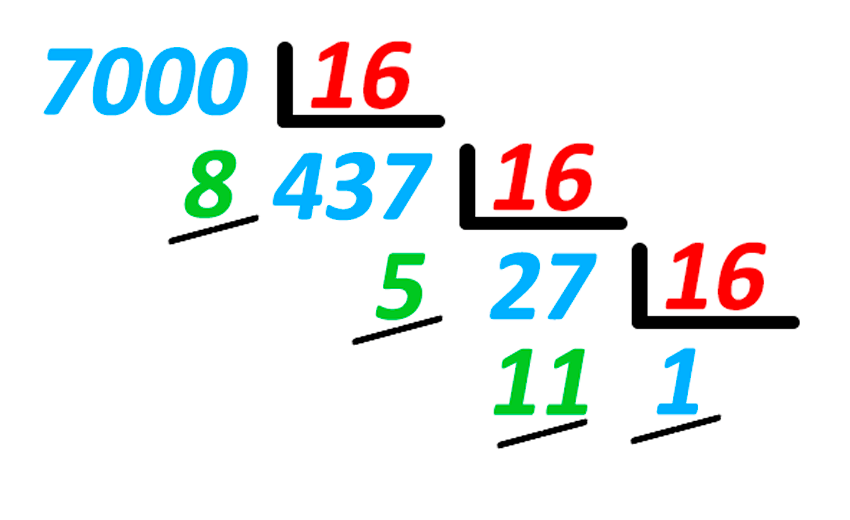
This lesson shows a possible solution for the problem P60816 (Reversed Number in Hexadecimal).
Exercise P60816
Exercise P60816 asks for a program that reads a number and writes its reversed hexadecimal representation. You must follow the convention of representing values between 10 and 15 with the letters from A to F.
For example, for the input 14 you must write the output E, for the input 16 you must write the output 01, and for the input 7000 you must write the output 85B1.
This is a possible solution:
from yogi import read

n = read(int)
if n == 0:  # special case
    print(0)
else:
    while n > 0:
        d = n % 16
        if d == 10:
            print('A', end='')
        elif d == 11:
            print('B', end='')
        elif d == 12:
            print('C', end='')
        elif d == 13:
            print('D', end='')
        elif d == 14:
            print('E', end='')
        elif d == 15:
            print('F', end='')
        else:
            print(d, end='')
        n = n / 16
    print()
The program starts by reading the number, which is stored in n. Then, there is a special treatment for the case where n is zero (otherwise the program would not write any digit), and a treatment for the general case.
In the general case, we keep dividing the number n by 16 until it is zero. This way all its hexadecimal digits are visited, from right to left. At each iteration, the last hexadecimal digit d is extracted and written. If it is a value between 0 and 9, d can be written directly. Otherwise, the corresponding letter is needed for each number between 10 and 15, which we do with a cascade of ifs.
Since each hexadecimal digit must be written after the previous one, the print statements include an end='' to indicate that nothing should be written at the end (not even the line break). The last print() without parameters is what writes the line break.
Remarks
The problem asks to write the result reversed because you wouldn't know how to do it forward (yet).
The cascade of
ifs could be avoided by using theordandchrfunctions, but we haven't seen those either.

Jordi Petit
Lliçons.jutge.org
© Universitat Politècnica de Catalunya, 2026